ZH-SIG-0001Date observed: 2026-07-30Score: 23/30

Robot Safety Is Moving Into the AI Stack

As robot foundation models gain broader autonomy, safety is shifting from a perimeter function toward a layered system spanning model reasoning, runtime intervention, hardware and certification.

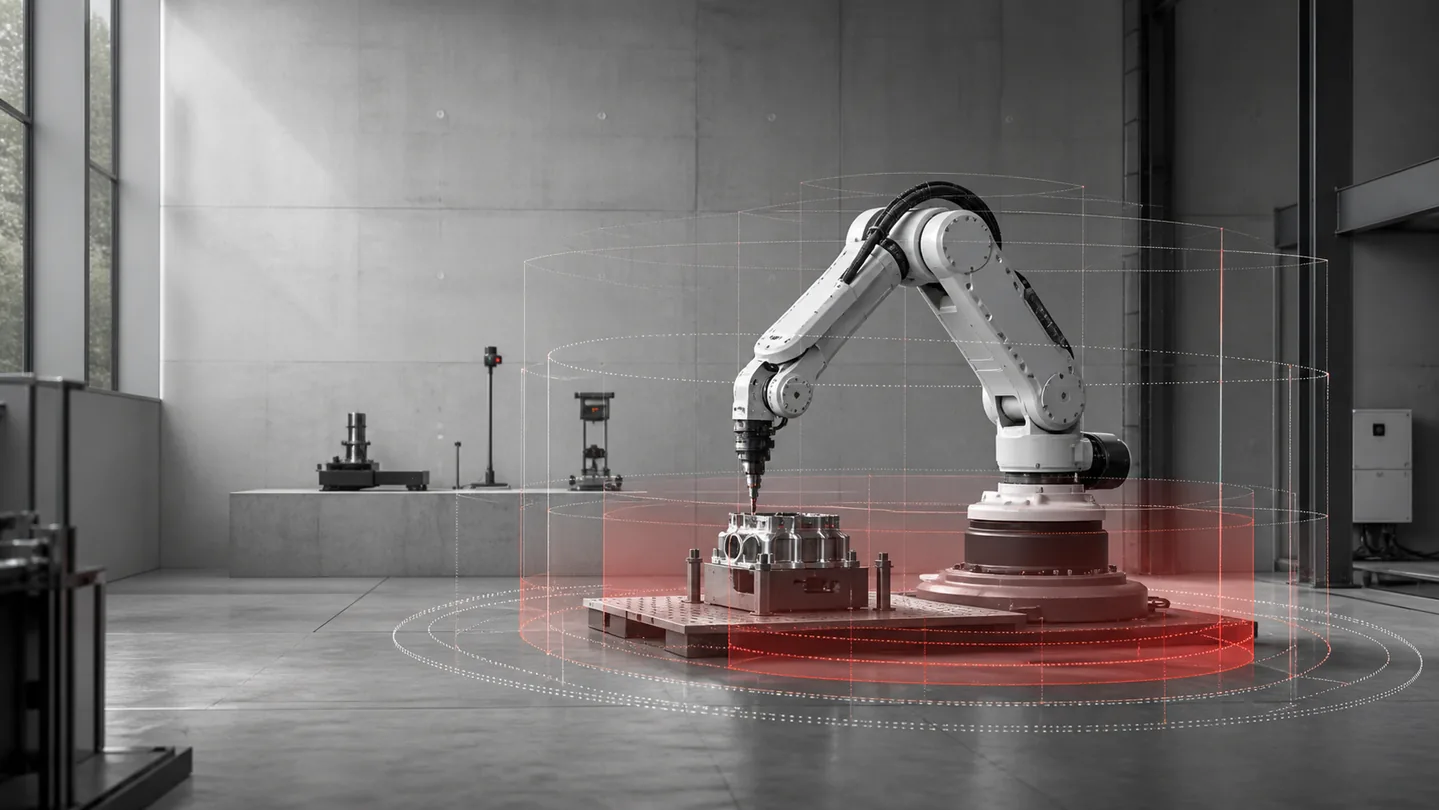
Industrial robotic arm operating within layered sensing and runtime safety boundaries

What happened?

FACT: NVIDIA introduced Halos for Robotics as a full-stack safety architecture spanning compute, sensor connectivity, software and inspection support. Google DeepMind subsequently introduced Gemini Robotics 2 with safety-oriented embodied reasoning and ASIMOV-Agentic, a benchmark covering unsafe requests, hardware faults, human proximity, uncertainty and requests for human intervention.

INTERPRETATION: Safety is beginning to move deeper into the physical-AI development stack. It is no longer framed only as fencing, collision avoidance or an integration-stage control.

Why it matters

More capable robots will operate in environments that are less structured than conventional robot cells. Construction sites, infrastructure projects and adaptive factories contain moving workers, changing geometry and uncertain conditions. If autonomy expands faster than verifiable safety, deployment will remain constrained regardless of model capability. Safety infrastructure may therefore become one of the decisive layers separating demonstrations from durable real-world adoption.

Evidence

NVIDIA announced Halos for Robotics on June 22, 2026, combining AI compute, sensor connectivity, a safety-oriented software stack and an inspection lab intended to support preparation for third-party certification.
Google DeepMind announced Gemini Robotics 2 on July 30, 2026. Its safety approach includes embodied reasoning, protective-stop tool calls and ASIMOV-Agentic evaluations for unsafe, infeasible and uncertain tasks.
ISO 10218-1:2025 and ISO 10218-2:2025 continue to place safety obligations across both the robot and its integration into a complete application or cell. This supports a layered interpretation of safety rather than reliance on a single model-level mechanism.

Counter-signal

Most published performance evidence currently comes from the companies developing the systems. Model benchmarks and controlled demonstrations do not establish safety in long-duration field operation. Google also describes some proximity-response capabilities as ongoing research rather than guaranteed safety-rated systems. Existing industrial standards require system-level risk reduction and integration controls; semantic reasoning cannot replace them.

What would change our mind?

We would weaken or reverse this Signal if independent evaluations show that model-level safety does not transfer reliably to field conditions, if certification bodies reject these mechanisms as meaningful safety layers, or if deployments continue to depend almost entirely on conventional separation and deterministic controls.

Sources and references
  1. nvidianews.nvidia.com
  2. deepmind.google
  3. deepmind.google
  4. deepmind.google
  5. www.iso.org
  6. www.iso.org
· ·