Across the first eight Zhaal signals, where is construction and physical AI moving from technical capability toward repeatable deployment, and which conditions appear to determine whether a system can scale?
Research / Structured Inquiry
ZH-RES-0001
Where Construction Autonomy Is Actually Scaling: An Eight-Signal Baseline
A qualitative baseline of eight Zhaal signals finds that construction autonomy is scaling first through task-native machines and the infrastructure surrounding them—not through general-purpose robotic labor.
Research question
Hypothesis
Near-term construction autonomy will scale first through task-native machines, bounded operational roles and shared enabling infrastructure—not through general-purpose embodied labor. The decisive constraints will increasingly sit around the machine: safety, project context, data operations, integration, supervision and procurement.
Methodology
This baseline uses qualitative cross-signal synthesis. Eight Zhaal signal records and two linked observations were reviewed as one evidence set. Each signal was coded across six dimensions: machine or system type, deployment environment, degree of human removal, task boundedness, enabling infrastructure and evidence maturity. Announced architectures, controlled demonstrations and live deployments were kept distinct. The analysis identifies recurring patterns; it does not assign market forecasts or treat vendor claims as independently verified performance.
Dataset
The dataset comprises ZH-SIG-0001 through ZH-SIG-0008 and their cited source documents, captured through September 7, 2026. It covers layered robot safety, autonomous excavation, military-scale robotic construction, robot-ready districts, responsible control of architectural AI, operator-led construction robotics, physical-AI data factories and shared construction intelligence. ZH-OBS-0001 and ZH-OBS-0002 provide the initial cross-signal interpretations against which this baseline was checked.
Models / systems
Systems reviewed include safety-oriented robot foundation models and runtime controls; autonomous excavators and other task-native construction equipment; construction-scale additive manufacturing; bricklaying and inspection robots; district-level navigation and access infrastructure; AI governance frameworks for design practice; synthetic-data and evaluation pipelines for physical AI; digital twins, construction agents and project-level intelligence platforms.
Metrics
The study uses six qualitative indicators: evidence maturity, degree of operator removal, task and environment variability, integration burden, safety and reviewability, and procurement or replication readiness. A system is treated as closer to scale when it demonstrates repeatable field use, explicit human and machine roles, integration with existing workflows, traceable controls and a plausible path to repeated procurement.
Results
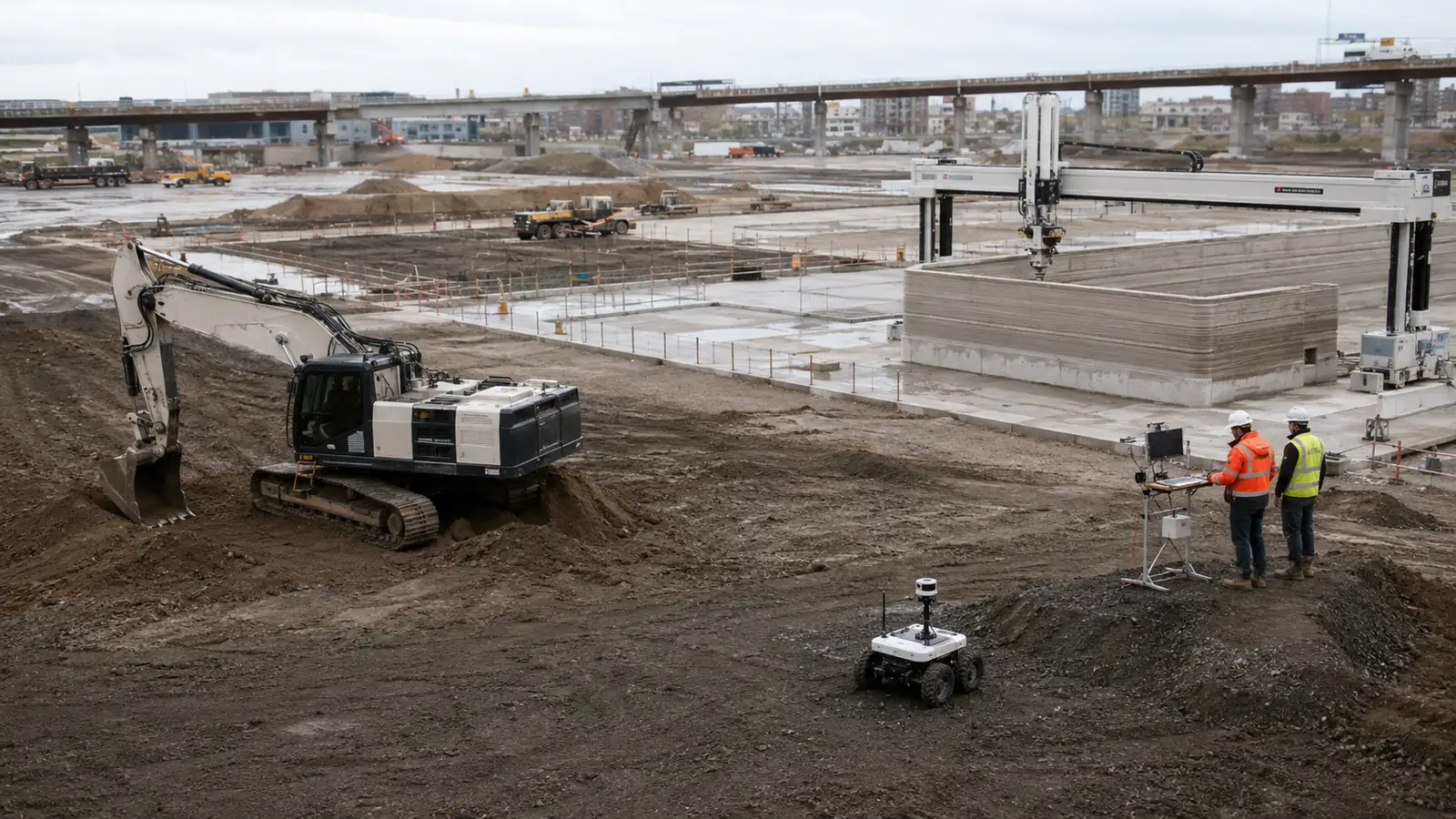
Four patterns emerge. First, physical production is furthest along where intelligence is added to machines already shaped for a construction task, especially earthmoving, material placement and repetitive installation. Second, inspection, imaging and project-data coordination are lower-risk entry points for more general robotic and agentic systems. Third, centralized buyers and controlled ecosystems—such as infrastructure owners, military programs and integrated districts—can assemble the standards, sites and procurement volume needed for early scale. Fourth, the bottleneck is shifting outward from model capability toward infrastructure: safety layers, data factories, continuously updated project context, permissions and human review. The sample therefore supports the hypothesis, but only as an early directional baseline.
Limitations
The sample is small, editorially selected and concentrated in construction, architecture and physical AI. Much of the evidence originates from vendors or project partners, and performance is not normalized across machine types or sites. Public announcements may overrepresent successful deployments and underreport integration cost, failure rates and human intervention. The study does not establish market size, productivity gains or causal superiority of one technical architecture. Its value is pattern detection and the definition of questions for subsequent research.
Conclusion
Construction autonomy is not arriving as a single technological wave. It is forming as a layered system of specialized machines, digital project context, data operations, safety controls and human supervision. The most credible near-term deployments reduce uncertainty by narrowing the task, using familiar equipment or controlling the operating environment. General-purpose autonomy remains important, but scale will depend less on isolated demonstrations than on whether organizations can make these surrounding layers reliable and repeatable. Future Zhaal research should track independent field performance, intervention rates, integration cost and repeat procurement across comparable projects.