ZH-SIG-0004Date observed: 2026-05-20Score: 22/30

Robot-Ready Districts Are Becoming a New Layer of Urban Infrastructure

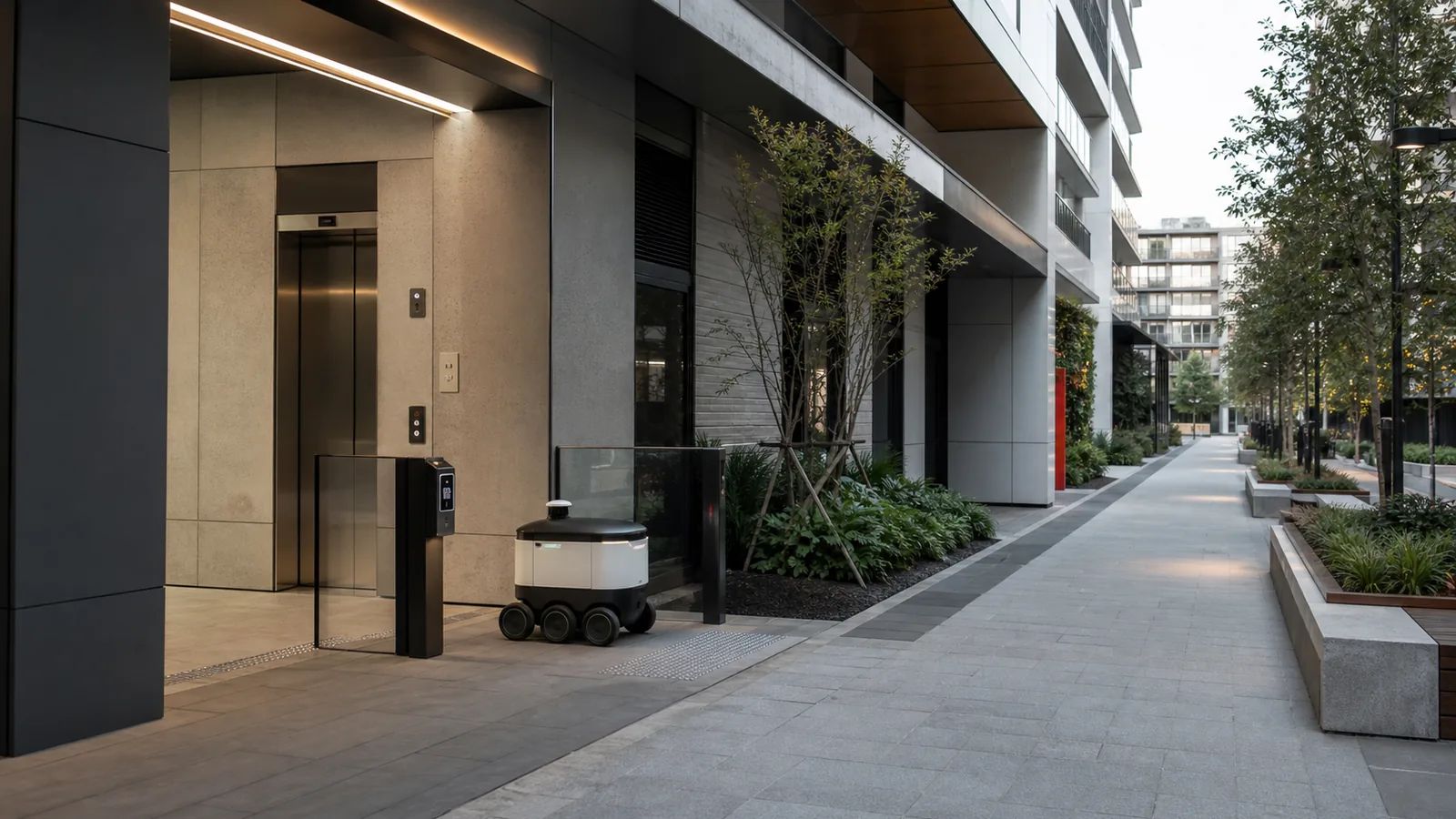
Singapore’s Punggol Digital District is treating paths, lifts, access systems, data platforms and regulation as shared infrastructure for multiple robot operators—not merely as a backdrop for isolated trials.

Delivery robot using shared access infrastructure beside an elevator in a robot-ready urban district

What happened?

FACT: On May 20, 2026, Singapore’s Infocomm Media Development Authority announced a living testbed at Punggol Digital District for robots from multiple operators in a mixed-use public environment. Initial services are planned to include food and parcel delivery, cleaning and security patrols. The program combines robot safety requirements, a precinct-level regulatory exemption and access to shared physical-digital infrastructure.

INTERPRETATION: The built environment is beginning to acquire a robot-operating layer. Paths, lifts, doors, gantries, digital twins, identity systems and regulatory rules are becoming coordinated infrastructure that allows different autonomous machines to function in the same district.

Why it matters

Many robot deployments fail to scale because each operator must independently solve access, mapping, connectivity, permissions and interaction with building systems. A district-level layer can turn these fragmented integration costs into shared infrastructure. For architects, developers and city operators, robot readiness may eventually become a design and operations requirement alongside accessibility, logistics, security and digital connectivity.

Evidence

IMDA, JTC and the Singapore Institute of Technology are coordinating the testbed with government agencies and industry partners. The announced framework covers multi-operator robots, safety standards, defined operating parameters and a precinct-level exemption under the Active Mobility Act. Punggol’s Open Digital Platform links a district digital twin with infrastructure such as lifts, doors and security gantries, allowing systems to be simulated before physical deployment. Initial design partners include Certis, DHL, Grab and QuikBot.

Counter-signal

At the time of the announcement, the multi-operator public testbed was scheduled to launch later in 2026; operating results had not yet been published. Punggol is a newly developed, centrally managed smart district with unusually integrated infrastructure, so its model may be difficult to reproduce in fragmented existing cities. A technically interoperable district also does not prove that robot services will be commercially viable or socially accepted.

What would change our mind?

We would weaken this Signal if the testbed remains a controlled demonstration, supports only a small number of manually coordinated routes, or fails to attract recurring commercial services. We would strengthen it if independent operators can use common interfaces across buildings, if safety and incident data is published, and if the infrastructure model is adopted in additional districts or retrofitted into existing urban areas.

Sources and references
  1. www.imda.gov.sg
  2. www.jtc.gov.sg
  3. www.mddi.gov.sg
  4. www.jtc.gov.sg
  5. www.mti.gov.sg
· ·