NVIDIA introduced an open Physical AI Data Factory Blueprint that combines data curation, synthetic-data generation, evaluation and workflow orchestration. Microsoft integrated the architecture with Azure services and released a public Physical AI Toolchain, while NVIDIA and Nebius published executable workflows for producing and validating model-ready datasets.
ZH-SIG-0007Date observed: 2026-03-16Score: 24/30
Physical AI Is Building Its Own Data Factories
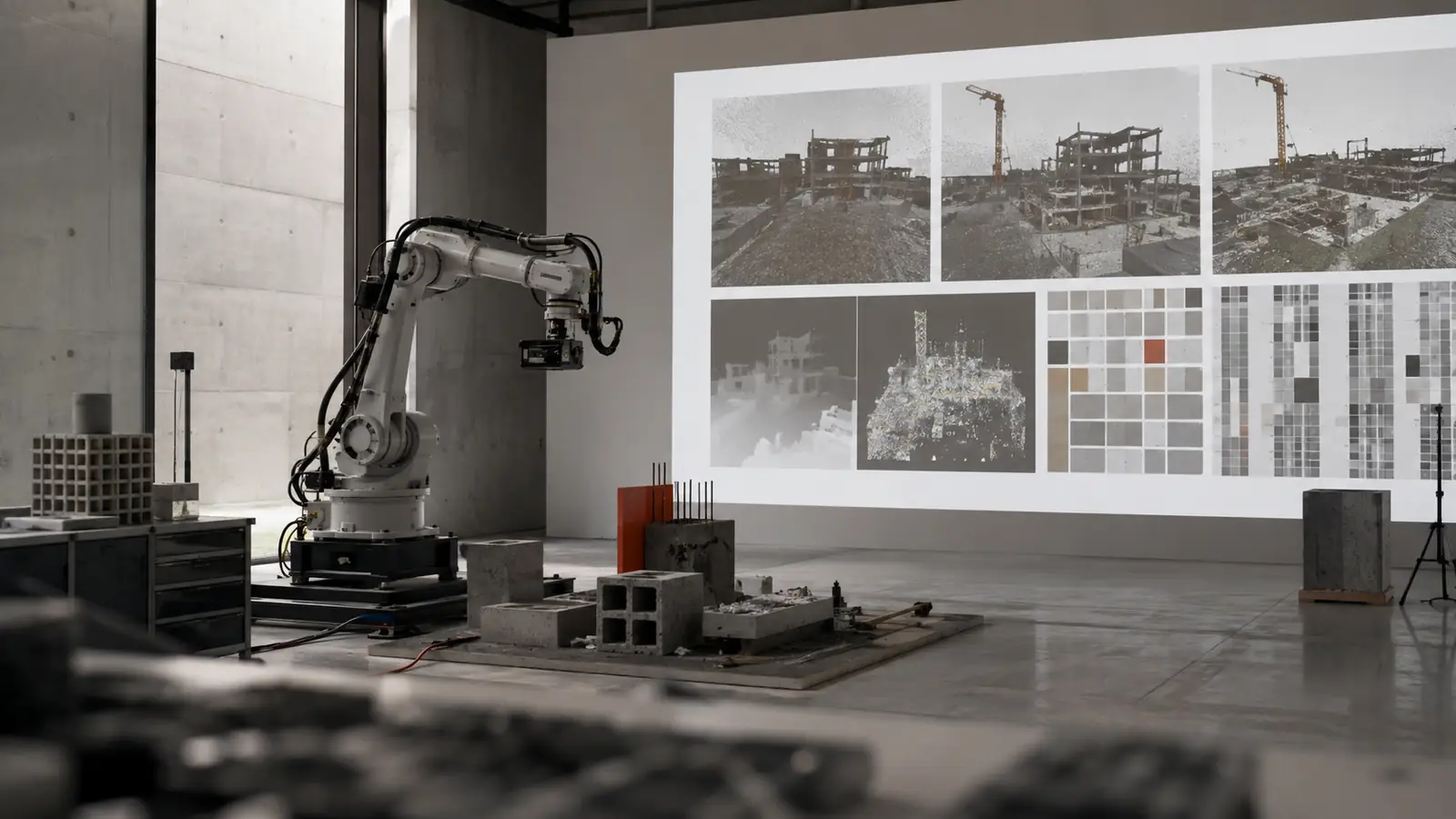
Physical AI is gaining a dedicated data-production stack: automated pipelines that curate real-world inputs, generate rare synthetic scenarios and evaluate model-ready datasets before robots enter live environments.
What happened?
Why it matters
Physical AI development is becoming an industrial data operation rather than a sequence of isolated model experiments. The ability to generate rare scenarios, label them, test physical consistency and repeat the process at cloud scale may become as important as the robot model itself. For the built environment, this creates a new infrastructure layer between digital twins and machines operating on real sites.
Evidence
The announced reference architecture covers curation, augmentation, evaluation and orchestration. Microsoft describes an enterprise toolchain connecting physical assets, simulation and cloud training. The public NVIDIA repository includes agent-driven workflows for synthetic inspection and perception datasets, and Nebius documents a deployable implementation across GPU and object-storage infrastructure.
Counter-signal
Most evidence currently comes from platform vendors and early adopters. Synthetic data can reproduce modeling assumptions and may fail to capture unanticipated site conditions, human behavior or hardware degradation. A standardized pipeline does not by itself demonstrate improved field reliability or lower lifecycle cost.
What would change our mind?
We would weaken this signal if independent deployments show that synthetic-data pipelines provide little improvement over carefully collected real-world data, if transfer to live environments remains unreliable, or if the operational cost of maintaining these pipelines exceeds their value outside a small group of large robotics developers.