Observation / Analysis

ZH-OBS-0002

The Real Bottleneck in Physical AI Is Deployment Infrastructure

Model capability is advancing faster than the systems required to deploy physical AI safely and repeatedly. The harder problem is increasingly the infrastructure around the machine: integration, supervision, certification and operations.

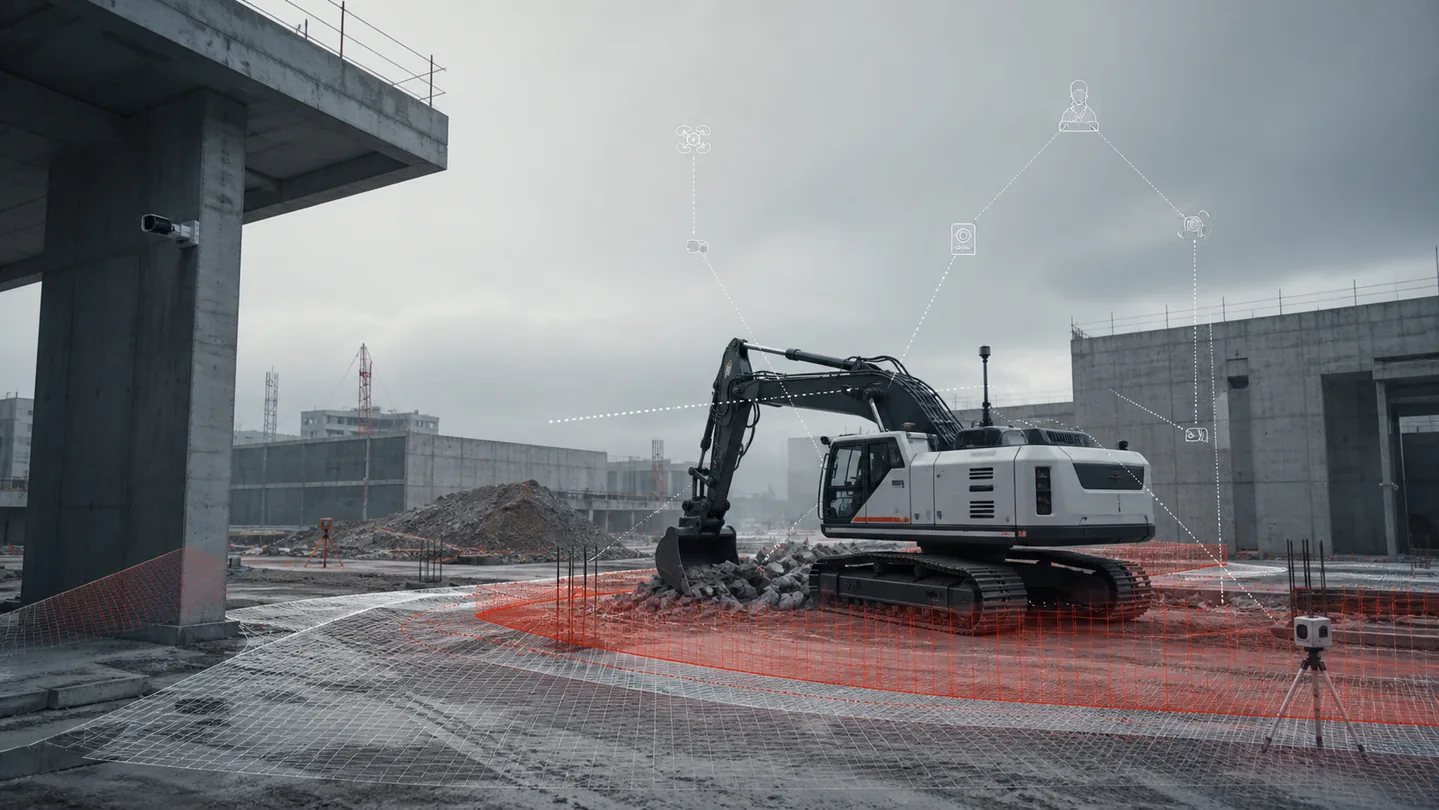
Autonomous excavator operating within layered sensing, safety and supervision infrastructure on a construction site

Thesis

Physical AI does not become operational when a model can perceive, reason or act in a demonstration. It becomes operational when an organization can deploy the system repeatedly, recover from exceptions, integrate it with existing assets and remain accountable for its behavior.

The emerging bottleneck is therefore deployment infrastructure: safety systems, maps and site data, task orchestration, machine interfaces, communications, regulatory permissions, maintenance, logging and human intervention paths. Model intelligence is necessary, but it is only one layer of a real-world operating system.

Evidence / Fact

The first Zhaal Signals show the same pattern across different environments. NVIDIA and Google DeepMind are adding safety reasoning, runtime intervention and evaluation layers around robot intelligence, while industrial standards continue to assign responsibility to the complete robot application. Bedrock’s excavator deployments require a retrofit sensor-and-compute system, an initial plan set by a site manager and an operational safety architecture—not only an autonomous model.

At Singapore’s Punggol Digital District, multi-operator robotics requires shared access to paths, lifts, doors, security gantries, a digital twin and a precinct-level regulatory framework. A systematic review of 375 construction-robotics studies found that operator-led workflows remain dominant, indicating that autonomy is constrained by integration and operating readiness as much as by individual robot capability.

Interpretation

The center of value in physical AI may shift toward the layer that coordinates machines with environments and institutions. A highly capable robot that cannot obtain access, exchange data, explain incidents, satisfy safety requirements or hand control to a human is not a deployable service.

This favors companies and public agencies that can build reusable interfaces across hardware, software and physical assets. It also changes the design brief for the built environment: robot readiness may eventually involve standardized access, machine-readable spatial data, charging, connectivity, authentication and safe zones in the same way buildings already accommodate people, vehicles and digital networks.

Counterarguments

Model capability remains a genuine bottleneck. Construction sites and public spaces are variable, partially observed and difficult to predict; no amount of infrastructure can compensate for weak perception, manipulation or generalization. Better foundation models may also reduce the need for carefully engineered environments by allowing robots to adapt to ordinary human spaces.

There is also a risk of overbuilding infrastructure around immature platforms. Proprietary interfaces can create lock-in, and highly instrumented testbeds may produce results that do not transfer to existing buildings or lower-resource settings. The bottleneck may differ by task: model capability can dominate one deployment while regulation or integration dominates another.

Conclusion

Physical AI should be evaluated as a system, not a model demo. The practical measures of maturity are sustained uptime, intervention rate, recovery from exceptions, integration cost, certification, maintainability and the ability to operate across sites.

The next phase of competition will not be won solely by the most intelligent machine. It will be shaped by whoever makes intelligence dependable inside the physical, regulatory and organizational systems where work actually happens.

Sources and references
  1. nvidianews.nvidia.com
  2. deepmind.google
  3. www.iso.org
  4. www.globenewswire.com
  5. www.imda.gov.sg
  6. www.jtc.gov.sg
  7. www.sciencedirect.com
· ·