ZH-SIG-0003Date observed: 2026-07-30Score: 26/30

Military Construction Is Becoming a Scale Market for Building Robotics

A U.S. Army production program has moved robotic concrete printing from prototype buildings to a ten-barracks deployment—showing how government procurement can create an early scale market for construction robotics.

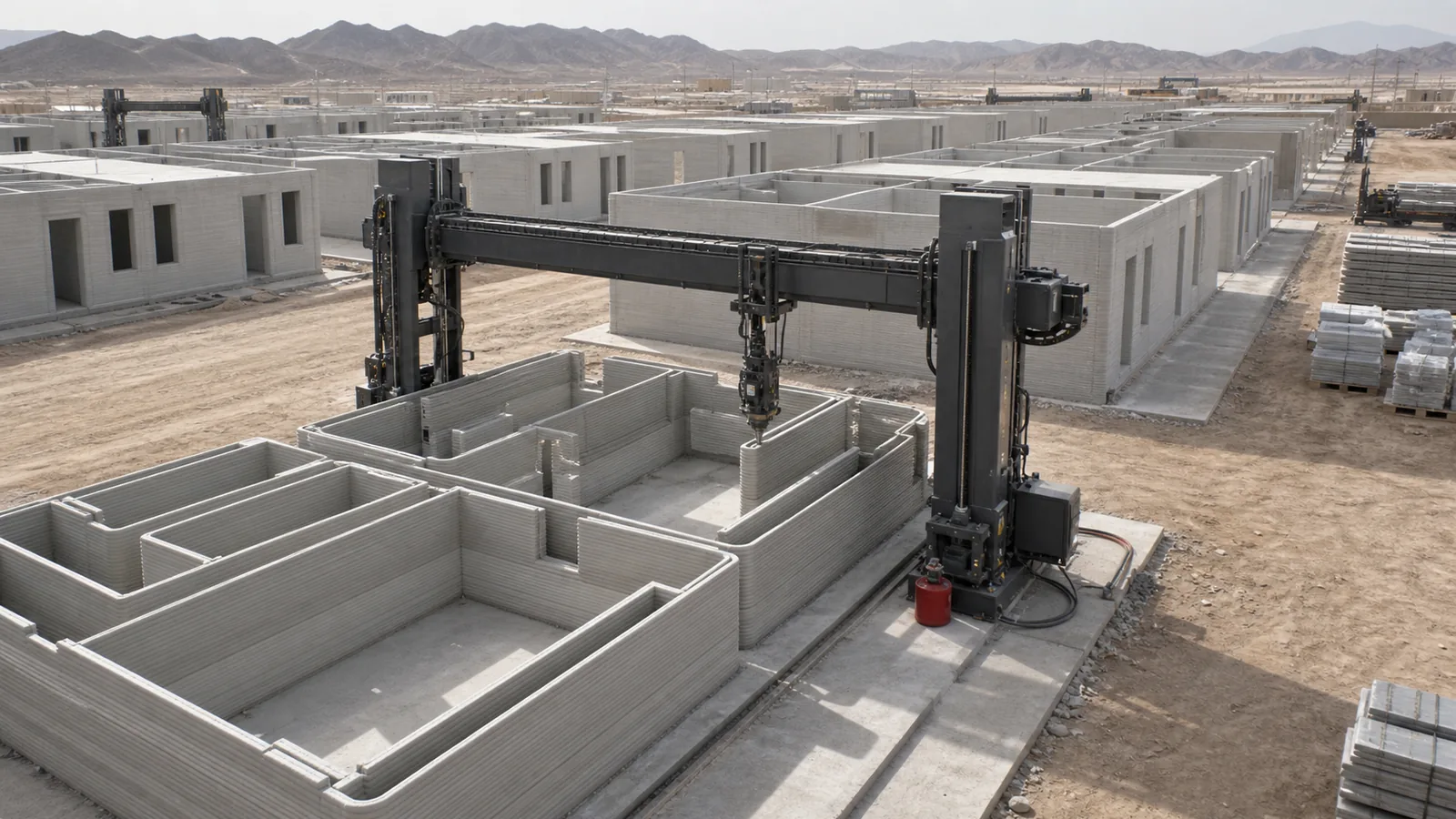
Robotic concrete-printing gantry constructing repeated barracks buildings at production scale

What happened?

FACT: On July 30, 2026, the U.S. Army and the U.S. Army Corps of Engineers reported the opening of the first buildings in a $62.8 million program for ten 3D-printed barracks at Fort Bliss, Texas. The Army said the printing phase for all ten buildings took 58 days and that the completed program will provide more than 78,000 square feet of covered area for up to 560 service members.

INTERPRETATION: Military construction is becoming an early scale market for building robotics. Government procurement is moving additive construction from isolated prototypes toward repeatable production programs with defined standards, budgets and delivery requirements.

Why it matters

Large public clients can absorb technical risk, commission repeated structures and create standards that private buyers may later reuse. The Fort Bliss program links robotics to an institutional need—rapid, resilient infrastructure—rather than novelty. If the model repeats across installations, military procurement could provide construction robotics with the utilization, validation and supply-chain learning needed to mature before broad commercial adoption.

Evidence

The Army describes the program as the largest deployment of robotic construction capabilities in the department to date. USACE reports that the structural walls were printed in 58 days, with delivery reported at roughly four times the speed of a typical construction model and about 9% below the project’s initial estimate. The ten-building production program follows earlier Fort Bliss prototypes and Department of Defense work that established Unified Facilities Criteria for additive concrete construction. ICON has also created ICON Prime, a dedicated government division, and reports additional military construction awards, although those broader contract totals remain company-reported.

Counter-signal

The robotic system automated wall construction, not the complete building. Roofing, windows, doors, utilities, HVAC and interior finishes still relied on conventional trades. The reported speed and cost comparisons come from a military project with repetitive building types and may not transfer to complex civilian construction. Government demand can validate a technology, but it can also create a specialized market that does not translate into competitive private-sector economics.

What would change our mind?

We would weaken this Signal if follow-on programs do not materialize, if lifecycle costs exceed conventional alternatives, or if the technology remains limited to repetitive wall systems under exceptional procurement conditions. We would strengthen it if multiple government agencies issue production contracts, publish comparable cost and schedule data, and adopt interoperable standards that allow more than one robotic construction provider to compete.

Sources and references
  1. www.army.mil
  2. www.swf.usace.army.mil
  3. www.army.mil
  4. www.defense.gov
  5. www.iconbuild.com
  6. www.iconbuild.com
· ·